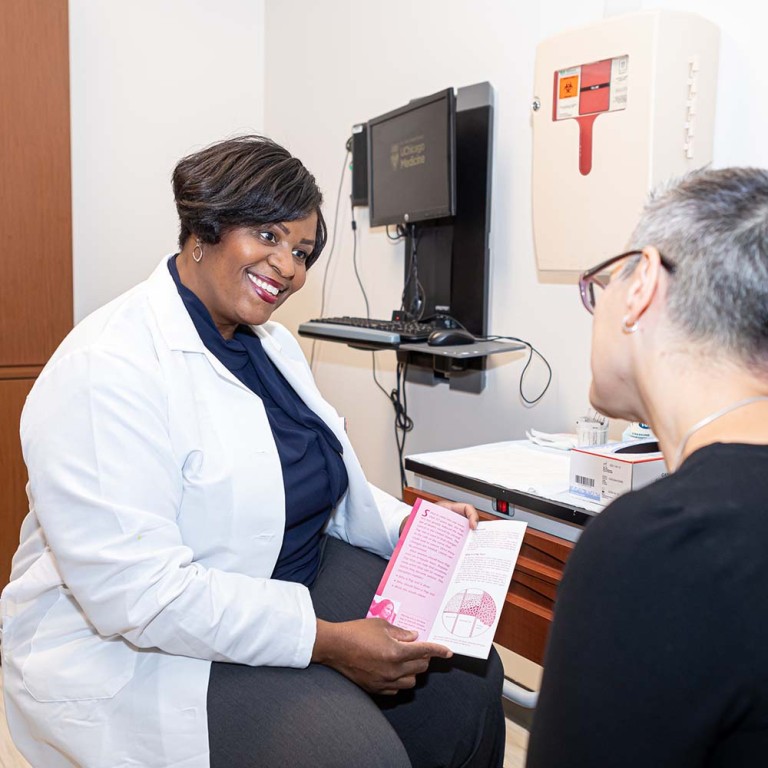
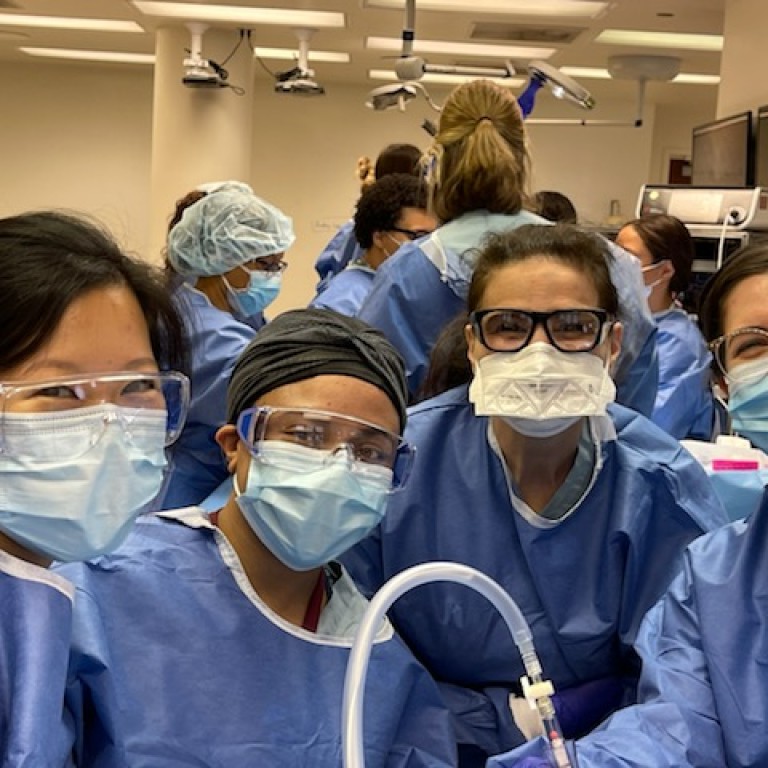
The Section of Reproductive Endocrinology and Infertility at the University of Chicago, under the leadership of Dr. Alberuni Musa Zamah, treats individuals with infertility and other reproductive health needs.
"It is a tremendous privilege and honor to be able to help patients build their families. Dr. Sana Salih and I believe that one of our key roles as infertility specialists is patient education. We want to empower patients, so they feel confident in choosing the family-building options that are best for their situation. I am proud to say that the University of Chicago Center for Reproductive Medicine and Fertility offers state of the art fertility treatments in a compassionate, patient-oriented setting." - Dr. Zamah
Clinical Care
Common conditions that may cause infertility include irregular menstrual cycles, polycystic ovarian syndrome (PCOS), endometriosis, uterine fibroids, diminished ovarian reserve (low number of eggs in the ovaries), and male factor-related issues such as low sperm count. We also specialize in the treatment of patients with recurrent pregnancy loss and miscarriage. Dr. Zamah has a clinical interest in difficult IVF cases, including recurrent implantation failure, cases with poor embryo quality, and oncofertility.
In addition to providing services for fertility testing and diagnosis, we offer a wide range of treatments for patients ranging from fertility drug therapy with artificial insemination to in vitro fertilization (IVF) with intracytoplasmic sperm injection (ICSI) and pre-implantation genetic testing of embryos (PGT), including sex selection. We also specialize in offering fertility preservation counseling and procedures such as egg and embryo freezing for patients wishing to preserve their future fertility. Additionally, we have expertise in offering a full complement of third-party reproductive services if needed, including the use of donor sperm, donor eggs, donor embryos, and gestational carriers (surrogacy).
We are committed to the philosophy that everybody who wants to build a family should be able to do so – when they are ready to do so. We have extensive experience with same-sex couples and understand the fertility options available for them. We offer both IVF and intrauterine insemination to support LGBTQ+ family building and work with third-party reproduction services for egg and sperm donors or gestational carriers. For individuals or couples who choose to delay family building, we offer banking of sperm, eggs, and embryos. Our team has experts in helping LGBTQ+ couples conceive and provides fertility-preserving services for transgender and gender non-conforming individuals through the University of Chicago Medicine Transgender Clinic for Affirmation and Reproductive Equity (CARE).
Some fertility problems are best treated by surgical interventions. Our team works closely with our board-certified colleagues in Gynecology and Minimally Invasive Surgery to deliver the best care while using the least invasive techniques available. Dr. Shari Snow, Dr. Sandra Laveaux, and Dr. Laura Douglass have advanced training in minimally invasive gynecologic surgical techniques and work closely with our fertility group to offer surgical treatments for fibroids through the Center for the Advanced Treatment and Research (CATeR) of Uterine Fibroids, endometriosis, uterine abnormalities such as uterine septum, uterine polyps, and fallopian tube abnormalities/tubal disease.
For individuals who experience cervical insufficiency/weak cervix, Dr. Douglass and her colleague Dr. Andrew Fisher are expertly trained in transabdominal cerclage surgery, a procedure that prevents pregnancy loss.
Patients with male-factor related fertility issues may benefit from the expertise of a reproductive urologist to discuss medical and surgical treatment options. Dr. Omer Raheem is fellowship trained in reproductive urology to provide comprehensive treatment for male factor-related fertility issues. Dr. Raheem offers innovative diagnostic tests including DNA fragmentation testing and fine needle aspiration testicular mapping for azoospermia men (no sperm) and advanced sperm retrieval procedures including, in-office testicular sperm aspiration (TESA), microsurgical testicular sperm retrieval (microTESE), and microsurgical vasectomy reversal. He also directs the UChicago Medicine Men’s Wellness Clinic to provide high-quality care to improve sexual function and reproductive health.
Research
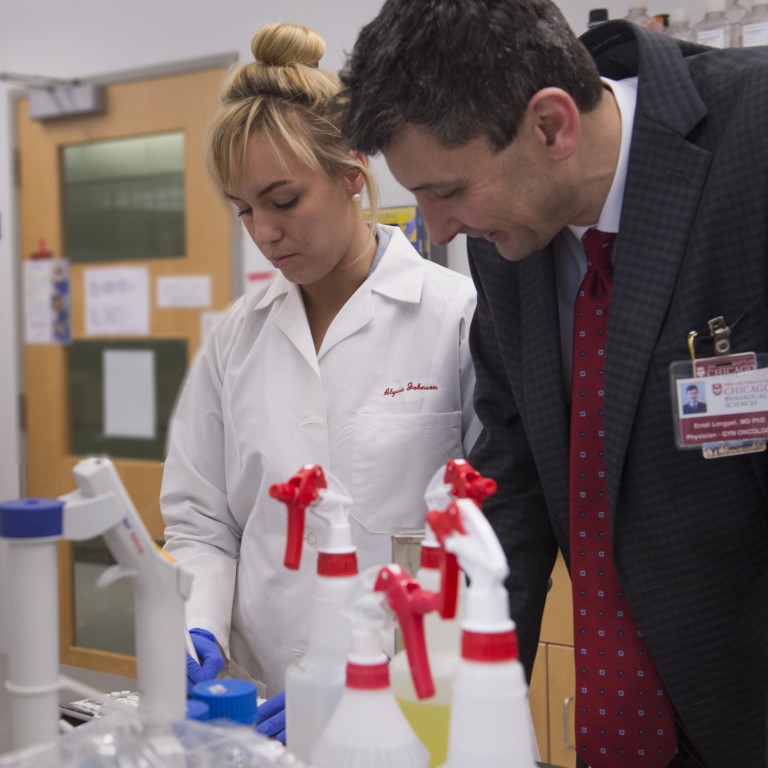
In addition to their clinical work, our Reproductive Endocrinology and Infertility section is active in performing research to investigate causes of infertility, advance and evaluate the efficacy of treatments and therapies, and improve the quality of care patients receive.
Dr. Zamah is interested in oocyte maturation and granulosa cell biology. Some of his recent publications include “Parenting intentions in transgender and gender-nonconforming adults,” International Journal of Gynaecology and Obstetrics; “Regulation of Insulin-Like Growth Factor 2 by Oocyte-Secreted Factors in Primary Human Granulosa Cells,” Journal of Clinical Endocrinology and Metabolism; and “Oocyte-Secreted Factors Synergize with FSH to Promote Aromatase Expression in Primary Human Cumulus Cells,” Journal of Clinical Endocrinology and Metabolism.
Dr. Sana Salih is committed to ongoing research, investigating new and innovative therapies that can improve fertility and fertility preservation for her patients. She is a collaborator in a National Institutes of Health (NIH)-funded project to study the genetic basis for recurrent miscarriage. Her work has been published in peer-reviewed journals such as Journal of Clinical Endocrinology & Metabolism, Reproductive Sciences, Fertility and Sterility and more.
Dr. Raheem is involved in clinical and transitional research to better understand patient-reported outcomes in reproductive and sexual health. He currently studies novel ways to evaluate various environmental and physical effects of substances like marijuana (Therapeutic Advances in Urology, 2021; Andrology, 2019), conditions like hypogonadism (Sexual Medicine Reviews, 2021) and cardiovascular disease (American Journal of Men’s Health, 2017), and other factors such as opioid therapy (American Journal of Men’s Health, 2016) on semen quality and overall reproductive health. Learn more about Dr. Raheem’s research here.
Contact Info & Locations
Our convenient locations in South Loop, Hyde Park (DCAM), and Hinsdale allow for quick monitoring appointments during treatment. Dr. Raheem can see patients with male-factor related reproductive health concerns at our River East location as part of UChicago Medicine Men’s Wellness Clinic. We also offer ultrasound monitoring at our Orland Park office. Virtual appointments are available for select services. Please call 773-702-6642 or visit the Center for Reproductive Medicine and Fertility for more information or to schedule an appointment.
Alberuni M. Zamah, MD, PhD
Chief, Reproductive Endocrinology & Infertility